 GLORY MACHINERY | Metal Polishing & Grinding Solutions
 Coil-to-Coil Polishing Lines: Improving Stainless Steel Surface Quality and Production Efficiency
Coil-to-coil polishing is a continuous process for converting stainless steel coil into a controlled decorative or functional surface before recoiling it for further fabrication. It is used where processors need consistent No.4, Hairline, Scotch-Brite or other satin-type appearances over long lengths of strip. Compared with isolated sheet finishing, a continuous route can reduce handling between stages and can establish a more stable surface pattern when material transport, abrasive contact and cleaning are properly coordinated.
The finished appearance is not determined by one machine head or one nominal abrasive grit. It is the result of the incoming coil condition, strip flatness, abrasive sequence, contact mechanics, tension, speed, cleaning and protective handling. For that reason, a coil-to-coil line should be evaluated as a process system. Production efficiency is meaningful only when the required surface appearance can be maintained through the coil and from batch to batch.
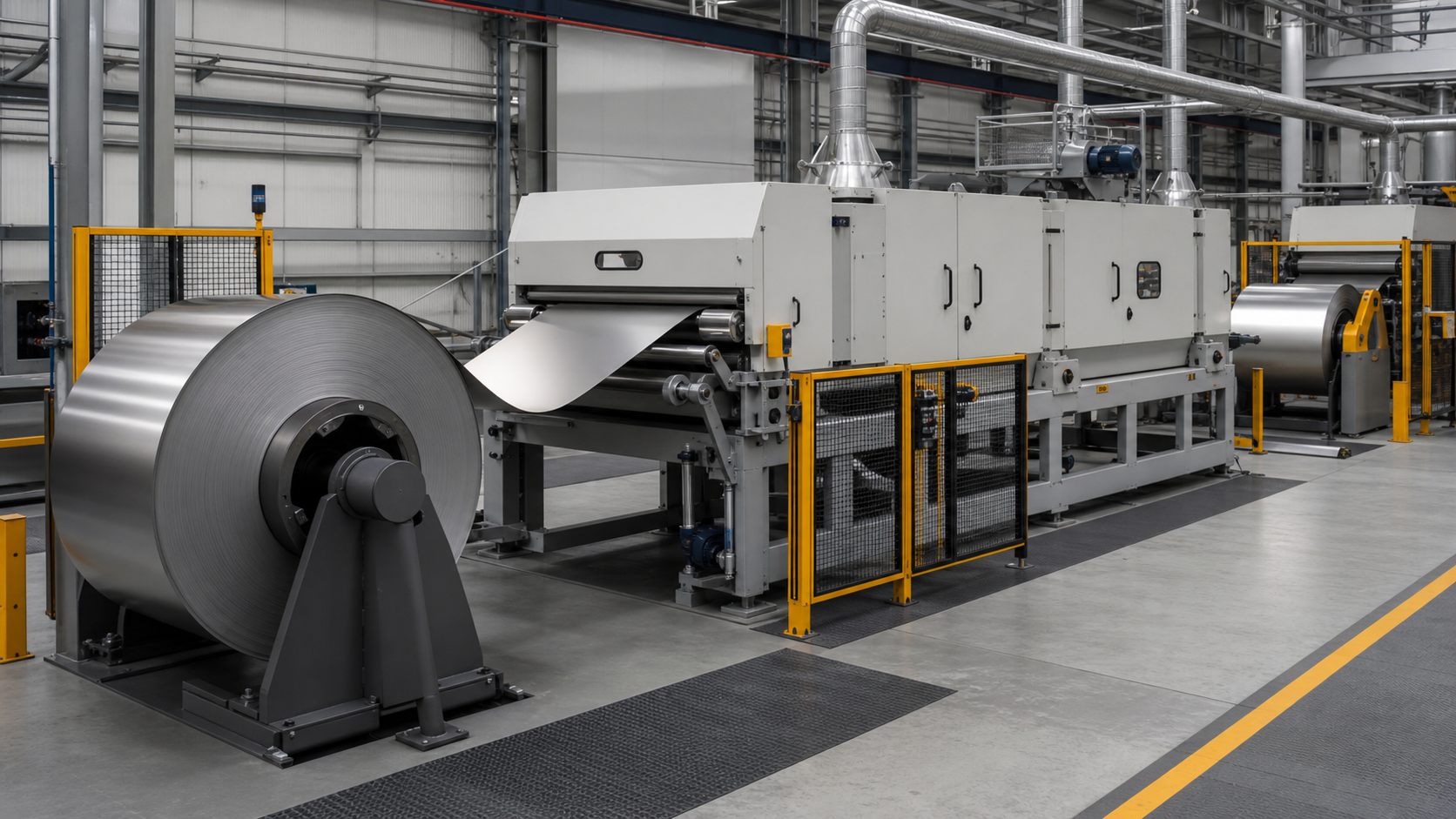
Current Industry Development
Stainless steel users in architectural metalwork, elevator interiors, appliances, food-service equipment and decorative fabrication increasingly specify a visual result rather than only a material grade. They may expect a consistent grain direction, uniform sheen, limited visible banding and a surface that remains protected through slitting, forming and installation. These expectations put greater importance on repeatable finishing and on agreement around physical samples.
Continuous coil finishing is attractive for processors supplying recurring specifications or long runs because it integrates uncoiling, strip control, abrasive finishing, cleaning, drying, film application and recoiling into one material flow. The route can also support downstream coil-based operations. It is not automatically the best answer for every order: sheet-to-sheet finishing remains valuable for cut sheets, diverse sizes, short runs and applications that need flexible batch changes. The selection should follow the product mix and approved surface standard.
Demand is also broadening beyond a single decorative category. No.4 normally has a visible directional grain; Hairline typically aims for a finer, more continuous linear texture; and Scotch-Brite finishing uses non-woven abrasive media for a softer satin character. Market terminology varies, so an approved sample and agreed viewing conditions are more dependable than a finish name alone.
Surface Finishing Technology
A coil-to-coil process begins with the incoming surface. Cold-rolled 2B and bright-annealed BA are common starting conditions, but their appearance and defect profile are different. Scratches, roll marks, stains, edge damage, waviness and local contamination can remain visible after polishing or require additional stock removal. Incoming-coil inspection should therefore be part of the process plan, not only a receiving task.
In the polishing section, coated abrasive belts or non-woven abrasive media contact the moving strip through a controlled contact system. The abrasive type, belt construction, backing, contact-roll hardness, pressure, oscillation, belt tracking and abrasive condition all influence scratch pattern and reflectivity. A nominal grit number is only a reference point; it cannot, by itself, define a final finish. The same stated grit can produce different appearances when the initial surface, abrasive product or machine setup changes.
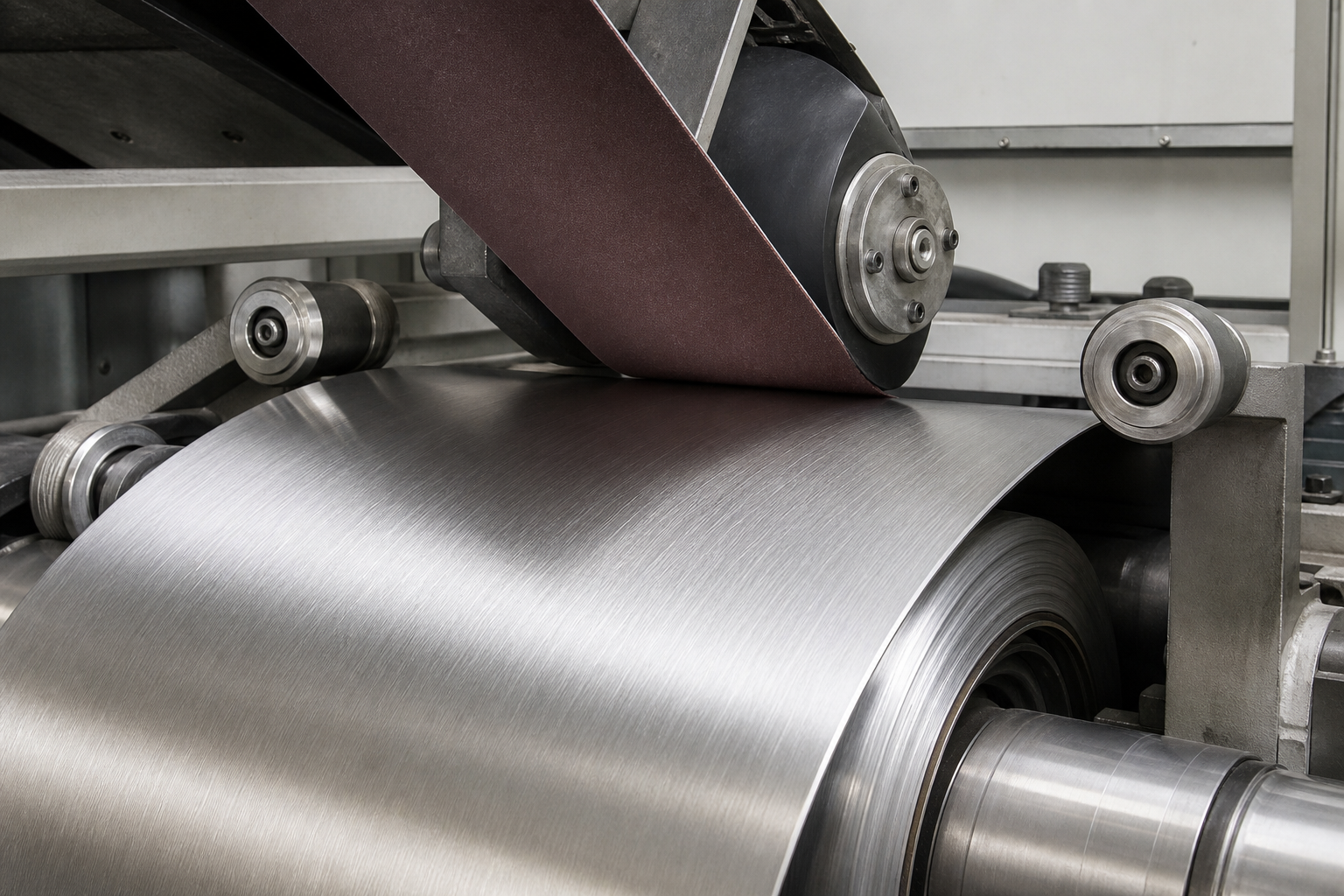
Multiple finishing heads can be arranged so that earlier stages remove defined surface defects and later stages refine the final texture. The appropriate sequence depends on the incoming coil and target sample. Excessively aggressive first-stage work may create deep scratches, heat marks or unnecessary material removal. Conversely, insufficient cutting can leave the previous surface pattern visible. Process development should use representative material and retain the approved settings as a controlled recipe.
Strip control is equally important. Uncoiling, braking, leveling where required, centering and tension control help keep the strip path stable across the working width. Changes in tension or lateral position alter the relationship between the abrasive and steel surface, potentially producing edge-to-center variation or irregular grain. Line speed, abrasive speed and pressure must operate as a tested window: increasing one variable without reviewing the others can affect dwell time, heat generation and surface uniformity.
After abrasive finishing, cleaning and drying remove residue before inspection and protective-film application. Wet processes may help control heat and transport debris, but they require effective fluid delivery, filtration, drying and wastewater management. Dry processes require suitable extraction and dust-control measures. The appropriate arrangement depends on the material, target finish, abrasive route and applicable factory safety requirements.
Challenges for Metal Processors
The most frequent challenge is translating a visual request into measurable production control. A customer request for “brushed stainless” may not state grain length, gloss range, inspection angle, allowable coil-to-coil variation or protective-film requirements. A signed sample, defined inspection lighting and a documented acceptance method reduce the risk of disagreement later in the supply chain.
Abrasive wear is another source of variation. New belts, conditioned belts and loaded belts do not cut identically. If wear is not monitored, the line can gradually change in brightness, scratch depth or heat generation before the difference is noticed. Operators need a practical belt-change strategy based on inspection results and the actual material route, rather than a universal replacement interval.
Surface quality can also be lost after the polishing heads. Residual slurry or dust, contaminated rollers, incomplete drying, incorrect film application and handling damage during recoiling can compromise an otherwise acceptable finish. Quality checks should cover the full route from coil entry to protected exit coil. Where close visual control is required, roughness readings can support inspection but should not replace visual comparison, because similar numerical roughness values can still look different.
How Advanced Polishing Equipment Improves Production
Advanced equipment improves production by making key variables more repeatable. A continuous transport system can reduce uncontrolled stops and starts, while stable guide rolls, centering and tension functions support a consistent strip path. Controlled head positioning and belt tracking help maintain abrasive contact across the width. Multiple stages make it possible to separate defect correction from final texturing instead of forcing one abrasive operation to do both jobs.
Automation can also support disciplined operation. Product recipes can retain validated operating parameters, while alarms and inspections help operators respond to belt wear, material changes or process interruptions. This does not remove the need for skilled judgement: the surface must still be checked against the approved sample and the line must be maintained. Its value is in helping a validated process be repeated with fewer uncontrolled changes.
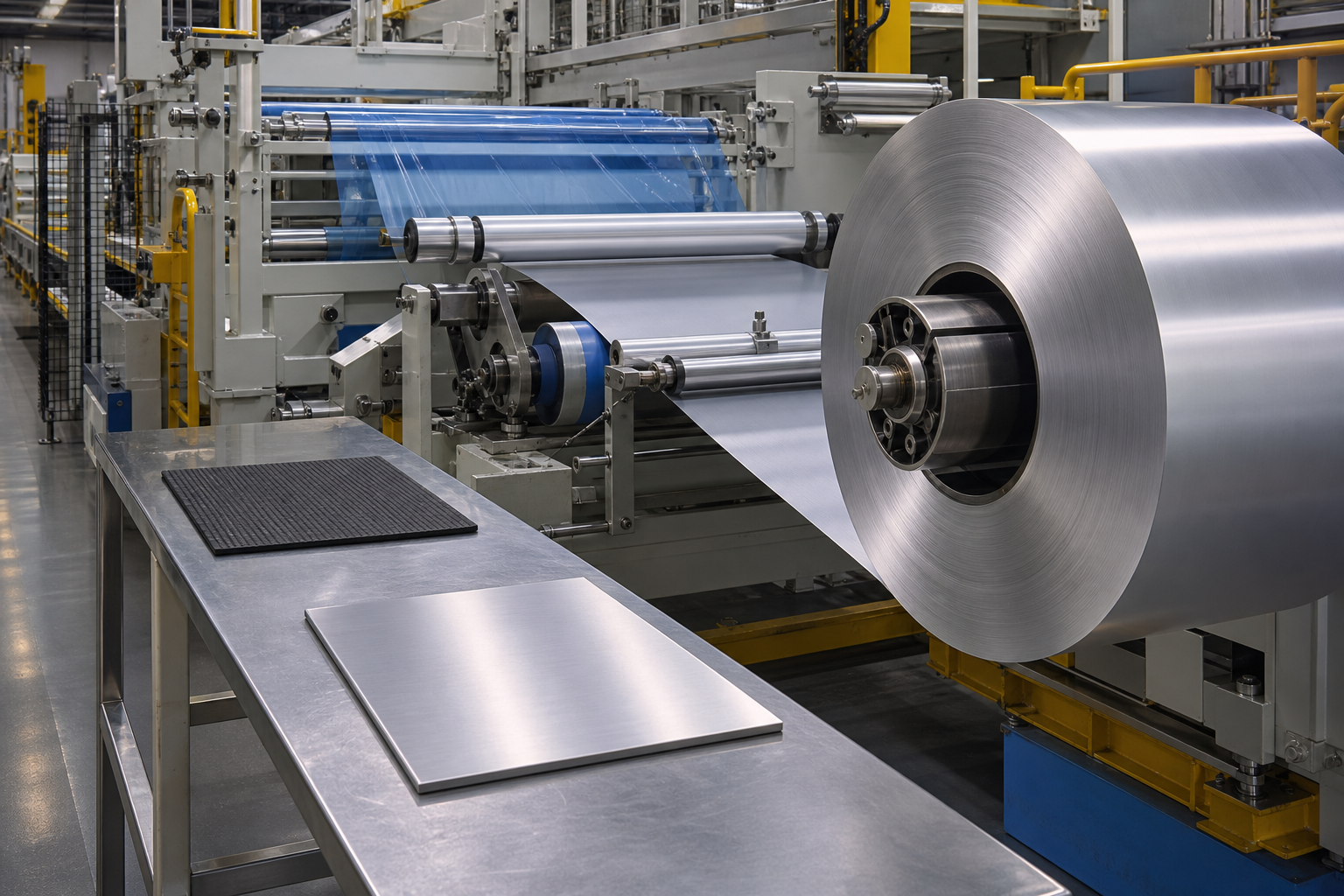
A well-designed coil route also reduces unnecessary material handling. Integrating cleaning, drying, inspection and protective-film application before recoiling helps retain the surface created by the polishing heads. The exact configuration should be matched to coil width, thickness range, grade, incoming condition, required finish, utility availability and downstream processing. These project-specific inputs require verification before equipment selection.
GLORY MACHINERY Solutions
GLORY MACHINERY supplies stainless steel polishing and finishing equipment for coil-to-coil and sheet-to-sheet processing. Relevant solution areas include No.4, Hairline, Scotch-Brite and rotary-disc 8K mirror finishing, together with titanium polishing lines for applications that require a different material-processing approach.
For a coil-to-coil project, the engineering discussion should start with the material grade, coil dimensions, starting surface, known defects, target sample, process sequence and downstream protection requirement. From these inputs, the polishing stages, abrasive arrangement, wet or dry route, material handling and automation scope can be evaluated. Final specifications, capability and performance targets are project-specific and require verification.
Conclusion
Coil-to-coil polishing lines are a practical route for producing repeatable stainless steel surfaces in continuous material flow. Their effectiveness depends on controlling the full process: incoming coil quality, abrasive contact, strip stability, cleaning, inspection and protection. Processors that define the target with
WeChat
Scan the QR Code with WeChat